Iran's Next Move: What the Retaliatory Playbook Looks Like From Here
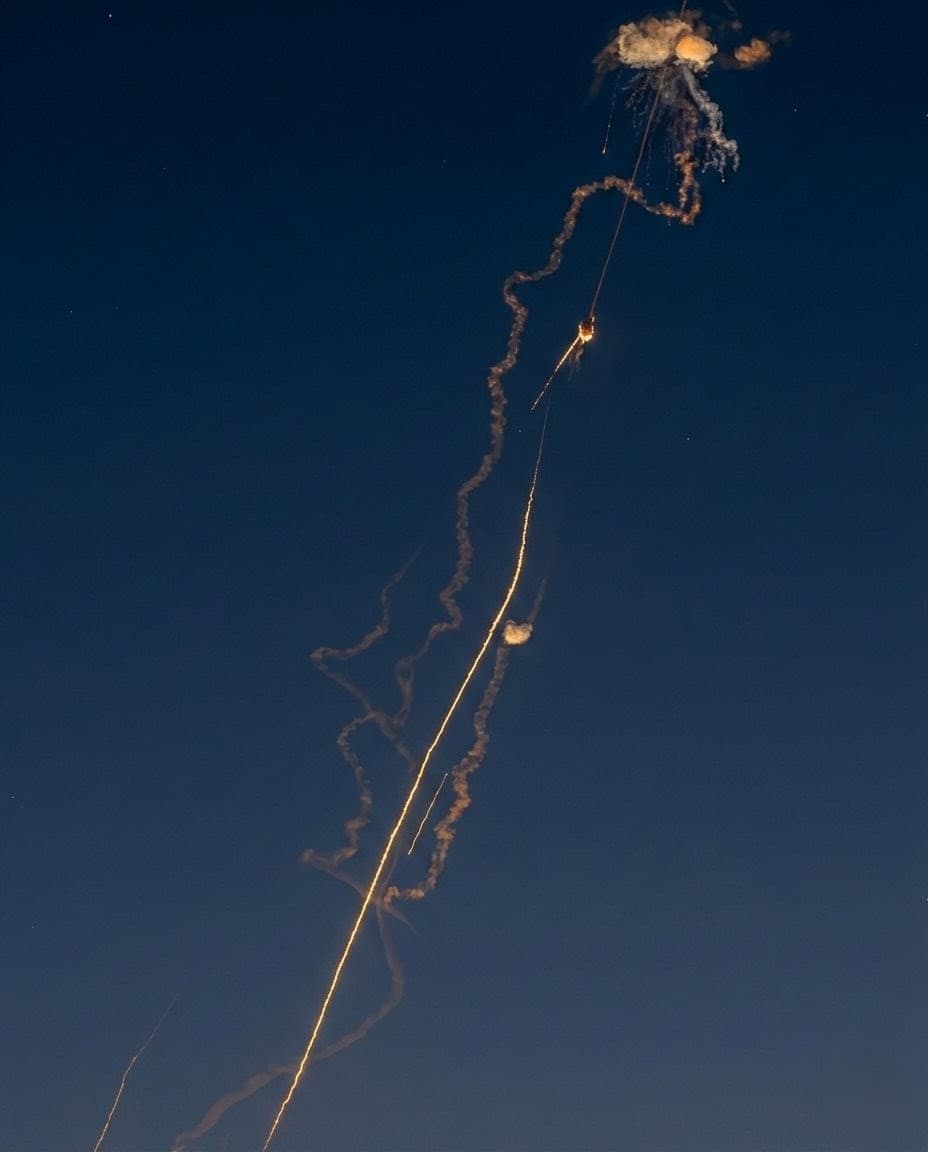
Twelve hours into Operation Epic Fury, Iran has already done something it has never done before: launched simultaneous ballistic missile strikes against U.S. military installations in four different countries in a single engagement. Al Udeid in Qatar, Ali Al-Salem in Kuwait, Al Dhafra in the UAE, NSA Bahrain. Plus dozens of missiles and drones at Israel itself, with interceptions confirmed over Tel Aviv and Jerusalem and at least one building hit in northern Israel.
This is not April 2024. That was a carefully choreographed operation with advance warning and limited objectives. This is an existential response from a regime that just lost its supreme leader and knows it might not survive the week.
The question everyone with skin in the game is asking right now: what comes next.
The saturation problem
Iran's missile strategy has always been built around volume. They can't match Israeli or American precision, so the doctrine is to fire enough projectiles to overwhelm layered defenses. The logic is simple math. If you shoot 200 missiles and the intercept rate is 90%, twenty get through. If those twenty hit populated areas or critical infrastructure, you've changed the calculus.
Saturday's initial barrage appears to have been largely intercepted. Patriot batteries across the Gulf engaged successfully. Kuwaiti air defenses knocked down inbound missiles targeting Ali Al-Salem. Al Udeid intercepts were confirmed with debris sparking secondary explosions in Doha suburbs that caused panic but no mass casualties. The IDF acknowledged its defenses are “not hermetic” amid the saturation attempts, which is a remarkably honest statement from a military that usually projects invulnerability.
The problem is sustainment. Iran's missile arsenal was estimated in the hundreds before the June 2025 strikes degraded significant portions of it. Saturday's strikes specifically targeted missile infrastructure, launchers, and production facilities. But Iran has spent decades dispersing assets, building hardened tunnels, and maintaining mobile launch platforms precisely because they anticipated this scenario.
The Shahed-type drones are the slower but persistent piece of the puzzle. They're cheap, they can be launched from almost anywhere, and they create a sustained threat that forces air defenses to stay engaged for hours. The combination of fast ballistic missiles and slow loitering drones arriving in waves is designed to exhaust interceptor stocks. That's the real threat and not any single missile, but the cumulative drain on Patriot and Arrow batteries over a multi-day campaign.
Strait of Hormuz
This is the economic weapon that Iran hasn't fully deployed yet and it's the one that should worry everyone the most.
Roughly 20% of the world's oil transits the Strait of Hormuz daily. Iran's IRGC Navy has been rehearsing interdiction operations in the strait for decades. They seized two foreign tankers near Farsi Island just weeks ago. During the Geneva negotiations in mid-February, Khamenei personally threatened to sink U.S. warships in the area. The IRGC conducted live fire drills in the strait and briefly closed it during exercises.
If Iran decides to close or seriously disrupt Hormuz, the economic shockwave would be immediate and global. Oil was already spiking on unverified reports Saturday afternoon. A sustained closure would push crude well past $120 per barrel and the downstream effects on everything from shipping to food prices would hit within days.
The IRGC Navy's fast attack craft and anti-ship missiles can't go toe to toe with a carrier strike group. But they don't need to. Mining operations, small boat swarms, and shore-based anti-ship missile batteries can make the strait functionally unusable for commercial traffic even if the U.S. Navy maintains military control of the waterway. The distinction between “militarily open” and “commercially viable” is the gap that matters.
Whether Iran pulls this trigger probably depends on how the next 48 hours develop. If the regime sees the strikes as a limited campaign that will end with some kind of off-ramp, they may hold Hormuz in reserve as a deterrent. If they conclude this is genuinely an existential campaign aimed at regime change, which is what Trump and Netanyahu have both explicitly said, then there's no reason not to use every tool available.
The proxy activation question
Iranian proxy groups across the region are in various states of alert and degradation. The picture is complicated because the network has been systematically dismantled over the past two and a half years.
Hezbollah is at its weakest point since Israel created it as a strategic problem in the 1980s. Leadership decimated, advanced weapons stockpiles degraded, southern Lebanon infrastructure destroyed, and the Lebanese government actively trying to disarm them. Reports indicate IRGC officers are now directly managing Hezbollah operations because there isn't enough indigenous Lebanese leadership left to run the organization independently. Could they fire rockets into northern Israel? Yes. Could they sustain a campaign? Very unlikely in their current state.
Regional analysts told the Jerusalem Post that domestic constraints could limit Hezbollah to “symbolic firings into open areas of northern Israel,” enough to show loyalty to Tehran without triggering another round of devastating Israeli response that Lebanon absolutely cannot absorb.
In Iraq the situation is more volatile. Kataib Hezbollah has real capability and real motivation. Their headquarters near Baghdad were hit in strikes connected to the operation and they've promised total war in response. PMF factions with IRGC ties maintain weapons depots and fighters positioned near U.S. installations. The threat to American personnel in Iraq, particularly around Erbil and the various bases in Anbar, is immediate and genuine.
The Houthis in Yemen are the wild card. They've demonstrated sophisticated strike capabilities over the past two years including anti-ship missiles and long-range drones. They're the least degraded element of the proxy network and the hardest to reach with conventional strikes. If Iran activates the Houthis for a coordinated Red Sea campaign simultaneous with Hormuz disruption, the economic impact compounds dramatically.
The information blackout
One factor that makes all of this harder to read is that Iran is operating under a near-total internet blackout. National connectivity dropped to 4% after the strikes. Cellular networks in Tehran are severely disrupted. State-affiliated media outlets including IRNA, ISNA, and Tabnak were knocked offline by what appear to be coordinated cyberattacks. Telegram channels are the only functional communication vector for most Iranian media.
This serves both sides in different ways. For the U.S. and Israel, it blinds Iranian command and control, disrupts coordination with proxy networks, and makes it harder for the regime to organize a coherent internal response. For Iran, it creates an information vacuum that they're already filling with atrocity claims, like the alleged school strike in Minab where death tolls escalated from 5 to 24 to 40 to 51 killed within hours, with no possibility of independent verification.
The fog of war is real and it's being weaponized by everyone involved. Anything you read in the next 72 hours that sounds too clean, too convenient, or too perfectly aligned with somebody's narrative, treat it with extreme skepticism.
Bottom line
Iran is on what military strategists call “death ground” , backed into a position where the regime perceives no safe retreat. A former NATO commander warned Saturday that this makes escalation more likely, not less. An animal that's cornered doesn't calculate. It attacks.
The indicators we're watching: follow-on missile salvos that test whether allied air defense interceptor stocks can sustain multi-day engagement. Any IRGC naval activity near the Strait of Hormuz. Kataib Hezbollah or other Iraqi PMF groups conducting kinetic attacks on U.S. bases. Hezbollah movement in southern Lebanon. And the restoration or further degradation of Iranian internet, because if communications come back up, protest mobilization becomes possible again, and that changes the internal dynamics completely.
For anyone in the region right now, particularly around U.S. military installations or in countries that have been directly targeted by Iranian retaliation: this is not the time to wait and see. If you have the option to leave, take it. If you don't have commercial options, find another way.
Need a way out?
Got SOF? connects you with vetted special operations professionals for evacuation, extraction, and crisis response.